Category: BLOG

The Unvaccinated Blood Conundrum: Growing Health Risks and Misconceptions Bioethics Education
April 16, 2026

The Unvaccinated Blood Conundrum: Growing Health Risks and Misconceptions

3 hypodermic needles

(Fox News) – Two patients became sicker after refusing standard transfusions, researchers found

An increasing number of patients are requesting “unvaccinated” blood for transfusions, which can delay care and pose risks to patients’ health, experts warn.

There is no evidence that unvaccinated blood presents any safety benefit, according to a new study published in the journal Transfusion.

There is currently no process for checking whether donated blood comes from vaccinated or unvaccinated donors, experts say. (Read More)

Read Article
The Uncharted Territory of Living with an Experimental Brain Implant Bioethics Education
April 16, 2026

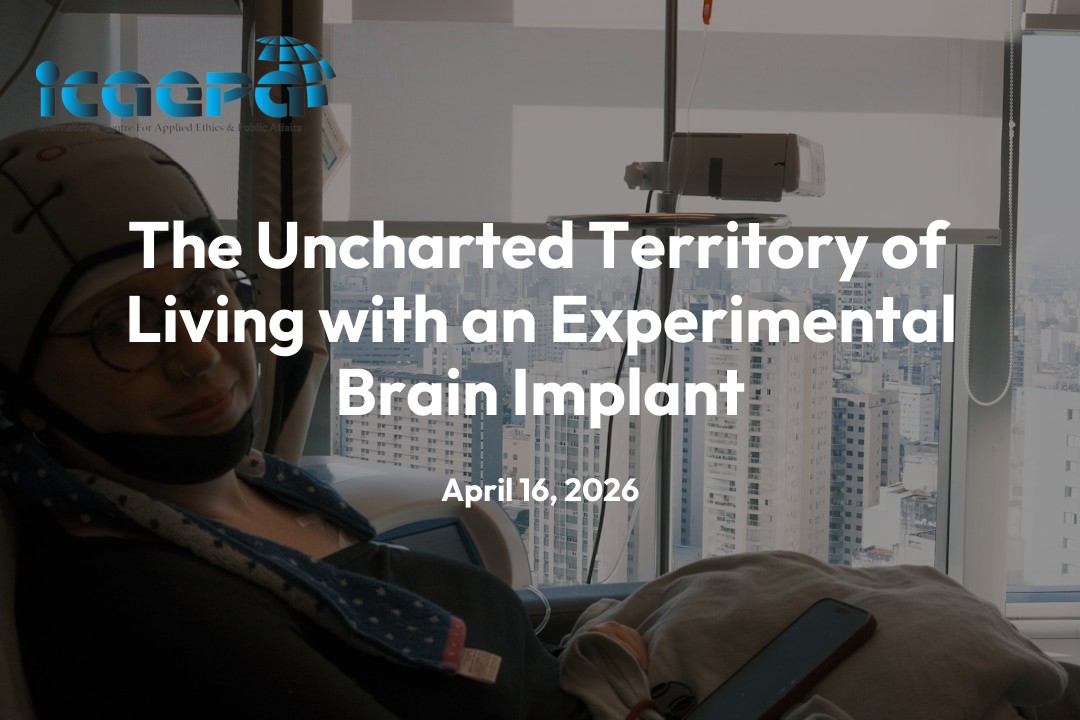
The Uncharted Territory of Living with an Experimental Brain Implant

MRI images of the brain

(IEEE Spectrum) – Early BCI users reveal what the technology gives—and takes

More people have gone to space than have received advanced brain-computer interfaces (BCI) like his. But a growing number of companies are now attempting to move the devices out of neuroscience labs and into mainstream medical care, where they could help millions of people with paralysis and other neurological conditions. Some companies even hope that BCIs will eventually become a consumer technology.

None of that will be possible without people like Imbrie. He’s a member of the BCI Pioneers Coalition, an advocacy group founded in 2018 by Ian Burkhart, the first quadriplegic to regain hand movement using a brain implant. (Read More)

Read Article
AI Disease Prediction Models Raised Concerns Over Dubious Data Bioethics Education
April 16, 2026

AI Disease Prediction Models Raised Concerns Over Dubious Data

A pipette dripping liquid into a cell array

(Nature) – The models are designed to predict someone’s risk of diabetes or stroke. A few might already have been used on patients.

Dubious data sets are being used to train artificial-intelligence models that are designed to predict people’s risk of stroke and diabetes, researchers report in a preprint on medRxiv. Some of the models seem to have been used in clinical settings although it’s not clear whether this has led to flawed diagnoses. At least two journals are investigating studies that used these data sets. (Read More)

Read Article
Surgeon Charged with Manslaughter After Removing Wrong Organ Bioethics Education
April 15, 2026

Surgeon Charged with Manslaughter After Removing Wrong Organ

An empty hospital bed

(NYT) – Dr. Thomas Shaknovsky tried to persuade his colleagues in the operating room that the liver he removed from a 70-year-old patient was a spleen, according to Florida’s Health Department.

When an Alabama man visited a hospital near Miami in August 2024, he reported a pain in his left side, near the spleen. Three days later, he died on the operating table, missing a different organ, his liver, on his right side.

A grand jury in Walton County, Fla., on Monday indicted a surgeon, Dr. Thomas Shaknovsky, 44, on a charge of second-degree manslaughter in the death of the patient, William Bryan, the Office of the State Attorney for the First Judicial Circuit said. (Read More)

Read Article
Meta Faces Backlash Over Plans for Facial Recognition in Smart Glasses Bioethics Education
April 15, 2026

Meta Faces Backlash Over Plans for Facial Recognition in Smart Glasses

a pair of Ray Ban sunglasses

(Wired) – More than 70 organizations, including the ACLU, EPIC, and Fight for the Future, say the AI smart glasses feature would endanger abuse victims, immigrants, and LGBTQ+ people.

More than 70 civil liberties, domestic violence, reproductive rights, LGBTQ+, labor, and immigrant advocacy organizations are demanding that Meta abandon plans to deploy face recognition on its Ray-Ban and Oakley smart glasses, warning that the feature—reportedly known inside the company as “Name Tag”—would hand stalkers, abusers, and federal agents the ability to silently identify strangers in public. (Read More)

Read Article
The Dark Side of ‘Sponcon’: When Parents Monetize Their Kids’ Milestones Bioethics Education
April 15, 2026

The Dark Side of ‘Sponcon’: When Parents Monetize Their Kids’ Milestones

a person taking a selfie

(Wired) – Latifi, an investigative journalist, raises serious ethical questions about parents broadcasting their kids online, particularly when they may be too young to consent to do so. And some of the anecdotes she provides about parents pushing their kids in front of the camera—doing sponcon for a menstrual pad to capitalize on a young girl’s first period, for instance—are objectively horrifying.

“Parents are aware of the risks” of posting their kids on social media, Latifi tells me, citing the example of a mom who noticed her 7-year-old’s posts got the most engagement when she wasn’t fully clothed—but continued posting her child in dance costumes. “But in the end, it doesn’t change their behavior.” (Read More)

Read Article
Anthropic’s Mythos Model Raises AI Security Concerns, Sparks Government Response Bioethics Education
April 14, 2026

Anthropic’s Mythos Model Raises AI Security Concerns, Sparks Government Response

Close up of a CPU

(The Hill) – The limited release of Anthropic’s new Mythos model is putting Washington officials on high alert after the AI firm’s warning about the model’s security risks sent shockwaves through and sparked debate in the tech industry. 

Within days of being informed of Anthropic’s new technology, the White House ratcheted up a multipronged response involving Trump administration leaders across agencies to evaluate just how powerful AI is becoming. (Read More)

Read Article
The Surprising Ways Cannabis May Affect the Aging Brain Bioethics Education
April 14, 2026

The Surprising Ways Cannabis May Affect the Aging Brain

cluster of marijuana leaves

(Washington Post via MSN) – Older adults — those 60 and older — are the fastest-growing group of cannabis users in the country. According to a 2022 study, adults over 60 who started using did so for medical reasons, including to treat pain and arthritis, sleep disturbances, anxiety and depression.

While more than three-quarters of those people found the cannabis either somewhat or very helpful, the question remains: What are the side effects? You may be particularly curious about brain effects, given concerns about cognitive decline. So what exactly does the research say? (Read More)

Read Article
The Unfortunate Future of AI-Powered Sunglasses Bioethics Education
April 14, 2026

The Unfortunate Future of AI-Powered Sunglasses

a pair of Ray Ban sunglasses

(NYT) – Plenty of people hate Mark Zuckerberg’s superintelligent, supercharged spectacles. I was ready to hate them, too.

Meta is investing heavily to promote its new product (a Super Bowl ad starring Spike Lee, a brick-and-mortar store on Fifth Avenue), which made me curious to take a peek through the eyes of the future. Yet A.I. glasses also feel so clearly unnecessary, so easily adaptable for malevolent ends. I was perfectly ready to hate them.

Instead, very quickly, I started to feel sorry for my sunglasses. They were like a kid who hasn’t done any of the reading but keeps being called on in class — and who also can’t make friends, because all of his classmates think he’s a spy. (Read More)

Read Article
Kentucky Leads the Way: New Law Mandates ‘Pause’ in Organ Donation Procedure Bioethics Education
April 14, 2026

Kentucky Leads the Way: New Law Mandates ‘Pause’ in Organ Donation Procedure

(WDKY Lexington via Yahoo!) – It’s now Kentucky law that if any medical provider observes any indication of life from the donor during organ harvesting, the procedure must stop.

House Bill 510 was signed into law on April 7, standardizing “pause in procedure” in the organ procurement process. The law was proposed after a Kentucky man’s organs were nearly harvested in 2021, while he was still alive. (Read More)

Read Article
Can AI Be a ‘Child of God’? The Intersection of Artificial Intelligence and Christian Ethics Bioethics Education
April 14, 2026

Can AI Be a ‘Child of God’? The Intersection of Artificial Intelligence and Christian Ethics

An old Bible

(WaPo) – The artificial intelligence company asked religious leaders for guidance on building a moral chatbot.

Anthropic, an artificial intelligence company valued at $380 billion, can take its pick of Silicon Valley talent thanks to the success of its chatbot, Claude. But last month, the start-up sought help from a group rarely consulted in tech circles: Christian religious leaders.

The company hosted about 15 Christian leaders from Catholic and Protestant churches, academia, and the business world at its headquarters in late March for a two-day summit that included discussion sessions and a private dinner with senior Anthropic researchers, according to four participants who spoke with The Washington Post. (Read More)

Read Article
The Ethics of Physician-Assisted Suicide: A Medical Perspective Bioethics Education
April 13, 2026

The Ethics of Physician-Assisted Suicide: A Medical Perspective

Nurse helping an elderly female patient

(WSJ) – We all took an oath to do no harm. That includes killing our patients.

Throughout medical school and residency, I always believed that people mattered. But it wasn’t until my conversion to Christianity that I understood why. Scripture teaches that people are made in God’s divine image. Medical schools don’t teach this moral reality, and therefore most medical schools no longer pledge to do no harm.

Instead, medical schools meticulously train physicians to look at patients only scientifically: knowledge through biochemistry, physics, anatomy, charts, machines, diagrams, lenses, statistical models, photographs, medical journals and pharmacology. In doing so, most doctors never learn to see the divine dignity of patients. (Read More)

Read Article
Dancing Beyond Disability: How Brainwaves Brought a Ballerina with MND Back to the Stage Bioethics Education
April 13, 2026

Dancing Beyond Disability: How Brainwaves Brought a Ballerina with MND Back to the Stage

A dancer spinning

(BBC) – A ballerina with Amyotrophic Lateral Sclerosis (ALS) says she was able to dance again after her brainwaves were used to power an avatar live on-stage in Amsterdam.

Breanna Olson, a mother of three, found out two and a half years ago she had ALS, the most common form of motor neurone disease (MND) and which, with no known cure, weakens muscles and over time affects speech, swallowing and breathing.

However, using sensors to measure the electrical activity transmitted from her brain, her motor signals could be converted into an digital avatar. (Read More)

Read Article
The AI Arms Race: A New Era of Autonomous Warfare Bioethics Education
April 13, 2026

The AI Arms Race: A New Era of Autonomous Warfare

silhouette of a drone flying in an orange sky

(NYT) – China, the U.S., Russia and others have ramped up their contest over artificial-intelligence-backed weapons and military systems. The buildup has been compared to the dawn of the nuclear weapons age.

China’s military display and the U.S. countermove were part of an escalating global arms race over A.I.-backed autonomous weapons and defense systems. Designed to operate by themselves using A.I., the technology reduces the need for human intervention in decisions like when to hit a moving target or defend against an attack. (Read More)

Read Article