Category: BLOG

Here’s What Happens When You Stop Taking Ozempic and Wegovy Bioethics Education
January 28, 2026

Here’s What Happens When You Stop Taking Ozempic and Wegovy

A picture of a slide adjusting scale

(WSJ) – “If you’re carrying 15-20 extra pounds,” it says, “medications like Wegovy can help jumpstart your progress.”

For obesity doctors and researchers, this kind of messaging is problematic. The blockbuster drugs—known as GLP-1s—are increasingly marketed as lifestyle fixes to help take off some weight. But they are actually designed as lifelong treatments for chronic diseases, namely obesity and Type 2 diabetes. 

That distinction matters. (Read More)

Read Article
After Donations, Trump Administration Revoked Rule Requiring More Nursing Home Staff Bioethics Education
January 28, 2026

After Donations, Trump Administration Revoked Rule Requiring More Nursing Home Staff

Two older people sitting on a bench, one in a wheelchair

(New York Times) – Executives who donated to the president’s super PAC met privately with him and urged a repeal of the rule, which was intended to prevent neglect of patients.

Less than one month after the lunch meeting, Trump administration lawyers quietly stopped defending the pending staffing rule in court against challenges from the industry.

Complete victory came a couple of months after that, when the White House approved a full revocation. The Department of Health and Human Services announced the repeal in a statement that echoed industry talking points, which have emphasized the industry’s difficulty in hiring enough staff, especially in rural areas.

The moves outraged groups representing patients. (Read More)

Read Article
Super Bowl-Bound Patriots and Seahawks to Avoid 49ers Training Ground Amid Ongoing Investigation on the Substation Theory Bioethics Education
January 28, 2026

Super Bowl-Bound Patriots and Seahawks to Avoid 49ers Training Ground Amid Ongoing Investigation on the Substation Theory

A football on an American football field.

(Yahoo! Sports) – Yes, the New England Patriots and the Seattle Seahawks have deliberately chosen to practice elsewhere. Their decision has gotten people talking, given the narratives surrounding the injury-ridden 49ers season.

The Niners’ training facility has come under scrutiny in the past few months due to an intriguing theory. It centers around an electrical substation adjacent to the 49ers’ training complex and Levi’s Stadium. Known online as the ‘substation theory,’ it suggests prolonged exposure to electromotive force (EMF) could be contributing to the team’s long-standing injury problems. (Read More)

Read Article
Memory and Speech Are Their Everyday Struggles. Then They Get to Sing. Bioethics Education
January 28, 2026

Memory and Speech Are Their Everyday Struggles. Then They Get to Sing.

A black and white photo of one person holding another's hand

(New York Times) – At the Singing Circle in Amsterdam, people with cognitive decline join together to lift their spirits and improve their lives.

They had come to the Concertgebouw for Singing Circle (“Zing-Cirkel”), a monthly program for people with brain diseases or injuries, or other troubles linked to memory or speech. Many of them face daily challenges to make sense of the world around them. But their objective here is simple: All they have to do is sing.

The program is run by Maartje de Lint, a former opera singer, who has been running another initiative called Singing for Health for about 15 years. She began offering the Singing Circle program at the Concertgebouw in October 2024, with a few sporadic trial sessions. This year, the Concertgebouw plans to host it once a month. (Read More)

Read Article
The first human test of a rejuvenation method will begin “shortly” Bioethics Education
January 28, 2026

The first human test of a rejuvenation method will begin “shortly”

Close up of an eye.

(MIT Technology Review) – In a bid to treat blindness, Life Biosciences will try out potent cellular reprogramming technology on volunteers.

ER-100 turns out to be the code name of a treatment created by Life Biosciences, a small Boston startup that Sinclair cofounded and which he confirmed today has won FDA approval to proceed with the first targeted attempt at age reversal in human volunteers. 

The company plans to try to treat eye disease with a radical rejuvenation concept called “reprogramming” that has recently attracted hundreds of millions in investment for Silicon Valley firms like Altos Labs, New Limit, and Retro Biosciences, backed by many of the biggest names in tech. 

The technique attempts to restore cells to a healthier state by broadly resetting their epigenetic controls—switches on our genes that determine which are turned on and off. (Read More)

Read Article
Health Insurance Is Now More Expensive Than the Mortgage for These Americans Bioethics Education
January 28, 2026

Health Insurance Is Now More Expensive Than the Mortgage for These Americans

Close up of a form and a hand with a pen

(WSJ) – Monthly health-insurance bills are rocketing higher for middle-income earners who rely on Obamacare

Millions of Americans are starting to see their monthly health-insurance bills rise, a new pressure point for a nation still frustrated with the high cost of living.

Many of those facing the most substantial dollar increases are middle-income Americans who buy health insurance through the marketplaces set up by the government’s Affordable Care Act, known as Obamacare.

Expanded subsidies for those insured under the ACA expired on Dec. 31—the central battle in last year’s record-long government shutdown. That shutdown ended with no resolution on the subsidies, and lawmakers haven’t passed legislation to revive them. (Read More)

Read Article
What the Rise of AI Scientists May Mean for Human Research Bioethics Education
January 28, 2026

What the Rise of AI Scientists May Mean for Human Research

beakers and other laboratory glassware

(Undark) – The goal, said Cowan, is to develop AI systems that can increase efficiency and scale up the production of science. And other companies like Sakana AI have indicated a belief that AI scientists are unlikely to replace human ones.

Still, the automation of science has stirred a mix of concern and optimism among the AI and scientific communities. “You start feeling a little bit uneasy, because, hey, this is what I do,” said Julian Togelius, a professor of computer science at New York University who works on artificial intelligence. “I generate hypotheses, read the literature.” (Read More)

Read Article
ProPublica Publishes Unreleased Data on the Origins of Generic Prescription Drugs Bioethics Education
January 28, 2026

ProPublica Publishes Unreleased Data on the Origins of Generic Prescription Drugs

Unlabeled pill bottles in a pharmacy

(ProPublica) – ProPublica on Friday published never-before-released data connecting generic drugs to the factories that manufactured them. The data powers Rx Inspector, our groundbreaking tool that allows you to find the factories where your generic drugs were made and their Food and Drug Administration inspection track records.

The data, which ProPublica created by linking several FDA datasets, has never been made available by the agency before. It will allow anyone to connect prescriptions to the facilities they were manufactured in by linking National Drug Code numbers to FDA Establishment Identifiers of drug manufacturing facilities. (Read More)

Read Article
Doctors Increasingly See AI Scribes in a Positive Light. But Hiccups Persist. Bioethics Education
January 28, 2026

Doctors Increasingly See AI Scribes in a Positive Light. But Hiccups Persist.

(KFF Health News) – Ambient AI scribes are being hailed by physicians as a game changer that helps free them to focus on their patients rather than their computer keyboard. By releasing doctors from the onerous and time-consuming task of documenting what happens during every patient encounter, early studies show, AI scribes may help reduce physician burnout and after-hours “pajama time” catching up on work in the evening.

The potential of AI to transform every aspect of the health care system — from patient care to clinical efficiency to medical innovation — is an area of intense focus, including by the Trump administration. (Read More)

Read Article
Doctors break with CDC on vaccine guidance for children Bioethics Education
January 28, 2026

Doctors break with CDC on vaccine guidance for children

3 hypodermic needles

(NBC News) – The nation’s leading group of pediatricians has issued its annual recommendations about which vaccines children should receive — marking the first significant break from the federal government’s proposed vaccine schedule in 30 years.

The American Academy of Pediatrics said Monday that it will continue to endorse vaccines protecting kids against 18 potentially life-threatening diseases, such as Covid, the flu, hepatitis A and B and measles.

While that guidance largely reflects what has previously been recommended, it no longer aligns with the Centers for Disease Control and Prevention’s guidance. On Jan. 5, the CDC reduced the number of diseases on the vaccine schedule from 18 to 11. (Read More)

Read Article
European countries including UK lose measles elimination status Bioethics Education
January 28, 2026

European countries including UK lose measles elimination status

map of Europe with a stethoscope

(Reuters) – Britain and several other European countries have lost their measles elimination status, the World Health Organization said on Monday, after a jump in infections across the continent.

Spain, Austria, Armenia, Azerbaijan and Uzbekistan also lost their status, and the WHO urged countries to boost vaccination rates, particularly among under-protected populations, to prevent the viral disease infecting more children. (Read More)

Read Article
Fear of ICE is driving patients away from medical care Bioethics Education
January 28, 2026

Fear of ICE is driving patients away from medical care

saline bag hanging from rack

(Axios) – The escalation of ICE activity in Minnesota is disrupting care at hospitals and clinics that already were navigating shifting legal standards on immigration enforcement in their facilities.

Why it matters: Health workers say many patients aren’t coming in for necessary care out of fear they’ll be detained by federal agents. (Read More)

Read Article
Hospices could see staff quit over assisted dying bill, charity boss warns Bioethics Education
January 28, 2026

Hospices could see staff quit over assisted dying bill, charity boss warns

Great Britain flags hanging over city square

(The Independent) – A charity boss fears some hospice staff and volunteers may resign if the assisted dying bill becomes law, as the sector braces for profound changes.

In an already under-resourced workforce, Hospice UK’s chief executive Toby Porter fears the passing of the controversial legislation could see workers who disagree with the bill exit the sector.

He said there were many complicated, unanswered questions around the future of end-of-life and palliative care, but he is certain all aspects of hospices would be significantly impacted. (Read More)

Read Article
Lab–grown LIFE takes a major step forward – as scientists use AI to create a virus never seen before Bioethics Education
January 28, 2026

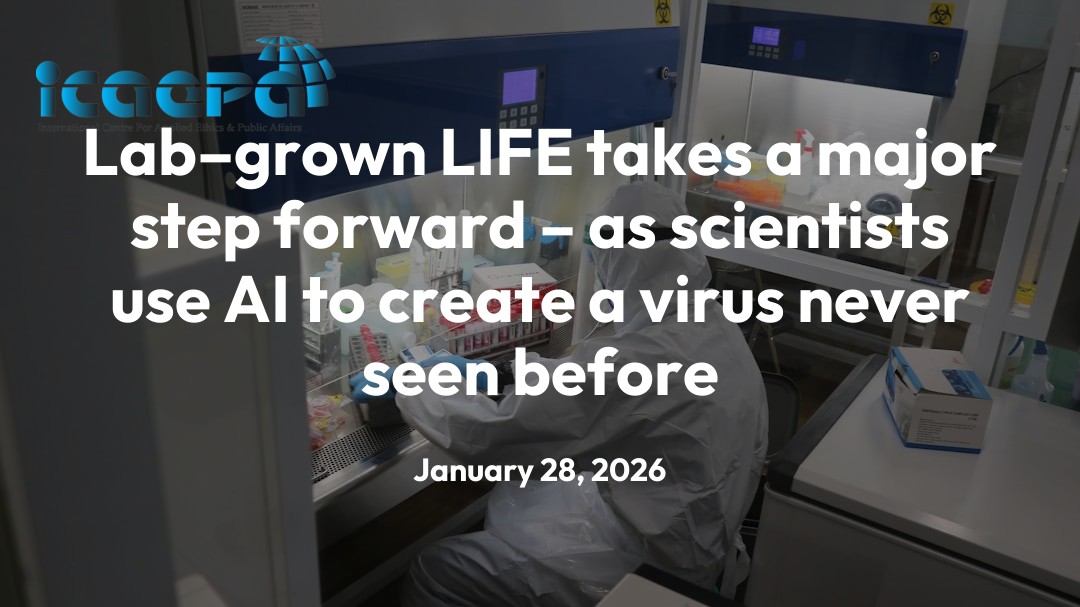
Lab–grown LIFE takes a major step forward – as scientists use AI to create a virus never seen before

A protein model

(Daily Mail) – Lab–grown life has taken a major leap forward as scientists use AI to create a new virus that has never been seen before.

The virus, dubbed Evo–Φ2147, was created by scientists from scratch using new technologies that could revolutionise the course of evolution.

With just 11 genes, compared to the 200,000 in the human genome, this virus is among the simplest forms of life.

However, scientists believe that the same tools could one day create entire living organisms or resurrect long–extinct species. (Read More)

Read Article
Thomas Fogarty, 91, Who Helped Revolutionize Vascular Surgery, Dies Bioethics Education
January 27, 2026

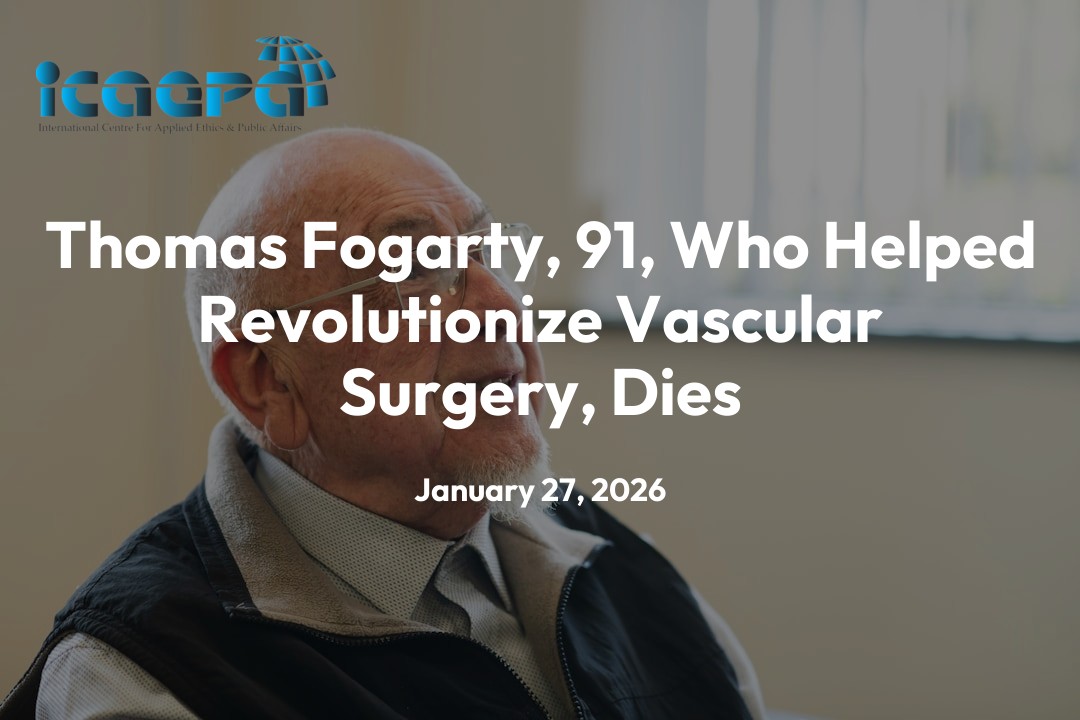
Thomas Fogarty, 91, Who Helped Revolutionize Vascular Surgery, Dies

black and white image of a stethoscope

(New York Times) – Drawing on his love of fly-fishing, he developed a balloon catheter that removes blood clots from patients’ limbs in a minimally invasive way. It has saved millions of lives.

Six-plus decades after its invention, the Fogarty catheter is used hundreds of thousands of times a year around the world in vascular, cardiac and thoracic surgeries. According to the American College of Surgeons and Fogarty Innovation, a nonprofit he founded, it remains the most widely used catheter for removal of blood clots and is credited with having saved an estimated 20 million lives globally. (Read More)

Read Article