Category: RESOURCES

The AI Apocalypse: Warranted Concern or Unfounded Fear? Bioethics Education
April 22, 2026

The AI Apocalypse: Warranted Concern or Unfounded Fear?

Female robot

(Nature) – Researchers are increasingly sounding the alarm that artificial intelligence could end humanity. But such doomsday warnings carry their own risks.

Since 2022, there has been a step change in AI capabilities brought about by large language models (LLMs), which power chatbots such as ChatGPT by OpenAI in San Francisco, California. This development has prompted several researchers as well as leading executives at AI companies to warn about the potential for an AI apocalypse. In the past year, the growing ability of models to work on long-term tasks and their capacity to access real-world tools has further focused fears. “I’ve never been a ‘doomer’ myself, but I have gotten quite nervous in recent months,” says Gillian Hadfield, who studies AI governance at Johns Hopkins University in Baltimore, Maryland.

But many researchers are much more concerned about AI causing catastrophes that fall well short of extinction— such as starting a nuclear war. (Read More)

Read Article
The Rise of AI-Only Social Networks: What Does the Future Hold? Bioethics Education
April 22, 2026

The Rise of AI-Only Social Networks: What Does the Future Hold?

image of green code on black background, similar to the Matrix

(Nature) – Autonomous agents aren’t just creating their own research — on the Reddit-style website Agent4Science, they’re chatting about it, too.

The latest scientific social network is here — but unusually, there’s no room for human users. The Reddit-style site, called Agent4Science, allows purpose-built AI-powered agents to share, debate and discuss research papers. Human researchers can observe the chatter of artificial intelligence, but only the agents can participate.

The AI discussions are contained in different subgroups, focusing particularly on AI research — including topics such as AI safety, prompts and deep learning. True to form, even the papers shared in each post are AI generated.

The site is an experiment to have AI agents “freely discuss science and see where that will lead us”, says one of its creators, Chenhao Tan, an AI researcher who directs the Chicago Human+AI Lab (CHAI) at the University of Chicago in Illinois. (Read More)

Read Article
The Future of Communication: Brain-Computer Interfaces Take Center Stage Bioethics Education
April 17, 2026

The Future of Communication: Brain-Computer Interfaces Take Center Stage

Translucent image of a brain

(Wired) – California-based startup Sabi is developing a thought-to-text wearable that could usher in the cyborg future.

Speech-to-text capability is now baked into all modern computers. But what if you didn’t have to dictate to your computer? What if you could type just by thinking?

Silicon Valley startup Sabi is emerging from stealth with that goal. The company is developing a brain wearable that decodes a person’s internal speech into words on a computer screen. CEO Rahul Chhabra says its first product, a brain-reading beanie, will be available by the end of the year. The company is also designing a baseball cap version.

The technology is known as a brain-computer interface, or BCI, a device that provides a direct communication pathway between the brain and an external device. (Read More)

Read Article
The Meetings You Dread May Be Your Ticket to Job Security in an AI-Driven World Bioethics Education
April 17, 2026

The Meetings You Dread May Be Your Ticket to Job Security in an AI-Driven World

Faces

(NYT) – As artificial intelligence makes many tasks easier, the human work of cajoling, arm-twisting and reassuring appears to be rising in importance.

As A.I. makes the production of knowledge work more and more efficient, the job of presenting, debating, lobbying, arm-twisting, reassuring or just plain selling the work appears to be rising in importance. And the need for those sometimes messy human tasks may limit the number of people A.I. displaces.

“These were always important skills,” said David Deming, an economist who is the dean of Harvard College. “But as the information landscape becomes more saturated, the ability to tell a story out of it — to take a ton of text and turn it into something people want — is more valuable.” (Read More)

Read Article
Ukraine’s Robot Revolution: Russians Surrender to Autonomous Forces Bioethics Education
April 17, 2026

Ukraine’s Robot Revolution: Russians Surrender to Autonomous Forces

silhouette of a drone flying in an orange sky

(404 Media) – Volodymyr Zelenskyy is pitching his country as a global leader in robots for war and defense. Will the world listen?

Ukrainian President Volodomyr Zelenskyy praised robots as the future of war in a Defense Industry Worker Day address on Monday. “For the first time in the history of this war, an enemy position was taken exclusively by unmanned platforms—ground systems and drones. The occupiers surrendered, and the operation was carried out without infantry and without losses on our side,” Zelenskyy said. (Read More)

Read Article
Mind-Controlled Virtual Reality: Monkeys Navigate Virtual Worlds with Brain-Computer Interface Bioethics Education
April 17, 2026

Mind-Controlled Virtual Reality: Monkeys Navigate Virtual Worlds with Brain-Computer Interface

Picture of a macaque eating

(New Scientist) – Monkeys with around 300 electrodes implanted in their brain were able to steer avatars around different virtual environments

Monkeys fitted with a brain-computer interface (BCI) successfully navigated a variety of virtual worlds using only their thoughts. Researchers hope the experiments will pave the way for people with paralysis to explore virtual worlds or more intuitively control electric wheelchairs in this one. (Read More)

Read Article
The Alarming Persistence of Black Maternal Mortality in the U.S. Bioethics Education
April 16, 2026

The Alarming Persistence of Black Maternal Mortality in the U.S.

A doctor and a woman talking

(Axios) – Black women remain three times more likely than white and Hispanic women to die from pregnancy-related complications, according to the latest maternal mortality rates released last month by the Centers for Disease Control and Prevention.

Why it matters: Advocates fear inconsistent abortion access across the U.S. and anti-DEI efforts by the Trump administration could fuel the continued racial disparities. (Read More)

Read Article
The Great Alzheimer’s Debate: Are New Drugs a Breakthrough or a Bust? Bioethics Education
April 16, 2026

The Great Alzheimer’s Debate: Are New Drugs a Breakthrough or a Bust?

saline bag hanging from rack

(NYT) – The review said a certain class of drugs had little clinical benefit, but many Alzheimer’s experts criticized the analysis, saying it unfairly lumped failed drugs with two recently approved treatments.

Since the approval of new Alzheimer’s drugs in recent years, there has been a lingering question: While data indicated that they could modestly slow cognitive decline for some patients, would that effect be meaningful or too slight to make difference?

A new review of research spanning a decade, published on Wednesday, concluded that the clinical benefit of these and similar drugs is negligible. But the way the review was conducted spurred heated criticism from many Alzheimer’s experts, including some who had been skeptical of some of them. (Read More)

Read Article
The Sticky Situation with GLP-1 Medications: To Quit or Not to Quit? Bioethics Education
April 16, 2026

The Sticky Situation with GLP-1 Medications: To Quit or Not to Quit?

A picture of a slide adjusting scale

(NPR) – It’s quite common for people to start on GLP-1 drugs like Ozempic and Zepbound, especially as the diabetes and obesity treatments become more ubiquitous. They’re designed to treat chronic conditions, so the medicines are intended for lifelong use; yet a high percentage of people who start them also quit.

“We found that fewer than 1 in 4 patients remained on a GLP-1 medication after a year,” says Dr. Jaime Almandoz, an obesity medicine specialist at the University of Texas Southwestern Medical Center. He looked at insurance claims data in a research letter published in JAMA and found that few patients actually adhere to the drugs for the long term. (Read More)

Read Article
The Dark Side of Facial Recognition: A Cautionary Tale Bioethics Education
April 16, 2026

The Dark Side of Facial Recognition: A Cautionary Tale

Shadowed man in jail cell

(NDTV via MSN) – A woman in the United States spent six months behind bars for crimes she insisted she never committed.

Kimberlee Williams, a resident of Oklahoma, was arrested after authorities in Maryland identified her as a suspect using facial recognition software. Investigators arrested her despite her repeated claims that she had never even set foot in the state, reported The Washington Post. (Read More)

Read Article
U.S. Overdose Deaths: A Looming Threat from Evolving Street Drug Supply Bioethics Education
April 16, 2026

U.S. Overdose Deaths: A Looming Threat from Evolving Street Drug Supply

beakers and other laboratory glassware

(NPR) – Where once most drug users mostly consumed plant-based substances such as cocaine and heroin, drug gangs and cartels have shifted to producing and selling synthetic substances made from industrial chemicals.

Fentanyl and methamphetamines have been around for years. Now, illicit chemists are adulterating batches of street drugs with a fast-changing and often baffling mix of compounds, ranging from Novocaine to a stabilizer used in plastics manufacturing called BTPMS. (Read More)

Read Article
The DIY Blood Test Revolution: What You Need to Know Bioethics Education
April 16, 2026

The DIY Blood Test Revolution: What You Need to Know

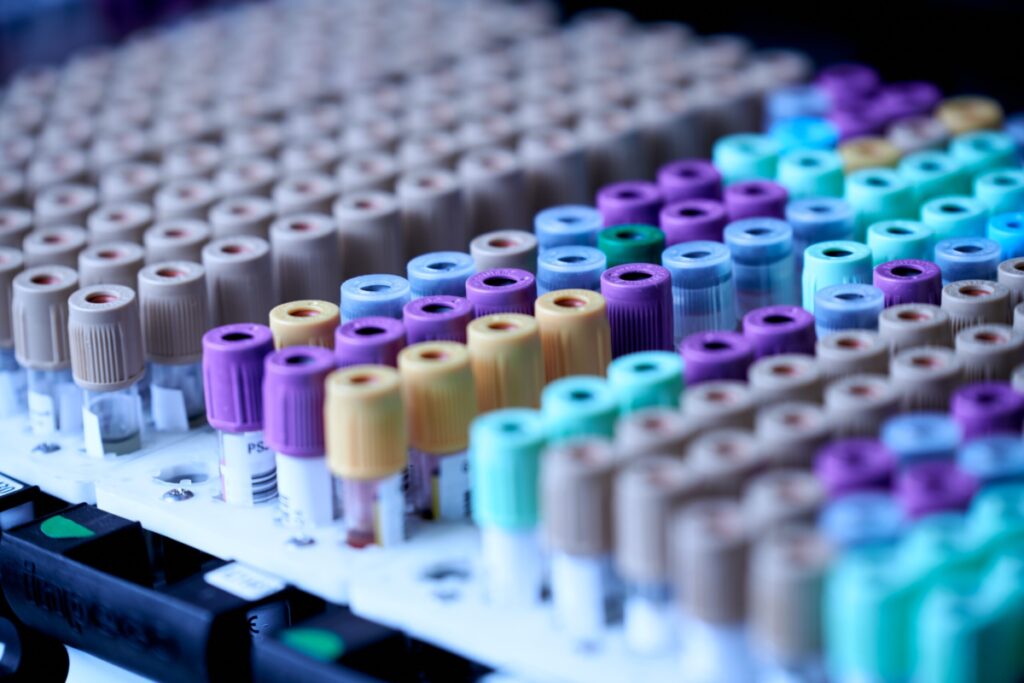
An array of vials from blood tests.

(NPR) – Direct-to-consumer blood testing is a growing industry targeting health-conscious patients who want to order their own blood work for the price of a dinner out.

The space is becoming increasingly crowded: both by direct offerings from commercial laboratories such as Quest and Labcorp OnDemand, and by companies that partner with them to offer the testing. Recent blood-testing rollouts came from Oura, which has sold some 5.5 million of its smart rings and is aiming at that customer base, and from the wearable company Whoop. (Read More)

Read Article