Category: BLOG

The Dark Side of Metrics: How Quantifying Life Can Make Us Miserable Bioethics Education
March 18, 2026

The Dark Side of Metrics: How Quantifying Life Can Make Us Miserable

A person taking blood pressure

(Derek Thompson Substack) – The quantified life has become a modern religion. But many of us are measuring life the wrong way.

In the late 19th century, the philosopher Friedrich Nietzsche famously criticized religion in part because he claimed its worshippers allowed an external system of values to stand in the place of the messy, beautiful work for discovering their own genius and agency. I have mixed feelings about Nietzsche’s critique of religion, but I think it applies profoundly to the state of life metrics. The quantified life has become a modern religion: a system of values that takes us over and instills deep values in us, even as it sometimes keeps us from living our own values and building the life we want.

C. Thi Nguyen is the author of the book The Score: How to Stop Playing Somebody Else’s Game. In today’s conversation, we talk about metrics, the games of life, and how to listen to the parts of our self that cannot be reduced to numbers. (Read More)

Read Article
The Rise of the ‘Human-Made’ Label: A Growing Backlash Against AI Bioethics Education
March 18, 2026

The Rise of the ‘Human-Made’ Label: A Growing Backlash Against AI

Silhouette of a man standing on a rock at sunrise

(BBC) – Organisations worldwide are racing to develop a universally recognised label for “human-made” products and services as part of the growing backlash against AI use.

Declarations like “Proudly Human”, “Human-made”, ‘”No A.I” and “AI-free” are appearing across films, marketing, books and websites.

It is in response to fears that jobs or entire professions are being swept away in a wave of AI-powered automation. (Read More)

Read Article
The Dark Side of Ketamine: When Mental Health Treatment Goes Wrong Bioethics Education
March 17, 2026

The Dark Side of Ketamine: When Mental Health Treatment Goes Wrong

a spoon with powder and packet of kratom

(WSJ) – The psychedelic-like anesthetic is at the heart of a booming online industry that promises relief from depression but has also led to harm

Just a few years ago, ketamine had mostly a dual existence: as an anesthetic to sedate patients in operating rooms and as a street drug known as “K” that can deliver out-of-body experiences. 

That changed after 2019, when the FDA approved a drug for treatment-resistant depression that shares some chemical similarities with ketamine. The drug, marketed under the brand name Spravato, must be administered in a specially certified doctor’s office or clinic. Patients are then placed under observation for at least two hours. 

Those hurdles drove more people to seek out ketamine itself, which can be prescribed for any use a doctor deems medically appropriate. It is FDA-approved only as an anesthetic, and its use for psychiatric conditions is “off-label,” meaning its safety and efficacy hasn’t been vetted by the FDA for that purpose. (Read More)

Read Article
Japan Leads the Way: World’s First Approved Treatment Made from Reprogrammed Human Cells Bioethics Education
March 17, 2026

Japan Leads the Way: World’s First Approved Treatment Made from Reprogrammed Human Cells

digitally enhanced image of an embryo

(Wired) – Researchers in Japan pioneered reprogrammed cells 20 years ago. Now the country has given the first-ever authorizations to manufacture and sell medical products based on the technology.

SMaRT, located in Suita City, Osaka Prefecture, is responsible for the production of Amshepri and is the world’s first commercial manufacturing facility dedicated to regenerative medicine and cell-based drugs derived from donor iPS cells. The iPS cells used as raw material for the product come from a stock provided by the Kyoto University iPS Cell Research Foundation, and the differentiation induction and manufacturing technologies are based on proprietary technologies from Kyoto University and other institutions. (Read More)

Read Article
The Hidden Dangers of Shingles: How a Common Virus May Be Accelerating Brain Aging Bioethics Education
March 17, 2026

The Hidden Dangers of Shingles: How a Common Virus May Be Accelerating Brain Aging

MRI images of the brain

(Wired) – Evidence suggests reactivations of the varicella-zoster virus may accelerate aging and raise dementia risk. Now scientists want to know if vaccines and antivirals could help protect the brain.

This remarkable case study, published in 2016, has inspired neurovirologists to look deeper into the connection between shingles and brain aging. For decades, shingles has been predominantly associated with a form of nerve pain known as postherpetic neuralgia, which can be so severe that it was once cited as the leading cause of pain-related suicide in the elderly. Now, research is starting to reveal the devastating impact that shingles can have on brain health.

According to Andrew Bubak, assistant professor of neurology at the University of Colorado Anschutz, the true burden of varicella-zoster “is totally underestimated. But it’s a very treatable virus.” (Read More)

Read Article
The Dark Side of Social Media: A Hazardous Product in Disguise Bioethics Education
March 17, 2026

The Dark Side of Social Media: A Hazardous Product in Disguise

Smart phone with social meda apps

(NYTs) – For two decades now, social media companies have been virtually untouchable, profitably floating above accusations that they normalize propaganda, addict children and degrade our character. Legally and politically, platforms like Facebook, Instagram and YouTube have been protected by an idea that they and others have promoted: that they are not just innovative technologies but also speech platforms, so that imposing any limits on them would amount to both censorship and a drag on technological progress.

That protection is finally starting to weaken, thanks to a growing realization that social media is also a matter of public health. Seen this way, social media appears as something less newfangled and more familiar: a defective, hazardous product. (Read More)

Read Article
The Desperate Cry of a Mentally Ill Teen: To Live or To Die? Bioethics Education
March 17, 2026

The Desperate Cry of a Mentally Ill Teen: To Live or To Die?

a model of the regions of the brain

(The Atlantic) – A Dutch psychiatrist gave lethal injections to patients with mental suffering, some of them teenagers. Does that make him a hero—or something else?

Oosterhoff’s patient had no physical illness, fatal or otherwise; he concluded, rather, that she was “mentally terminal.” An administered death would be preferable, he thought, to prolonged suffering or the possibility of unassisted suicide. To comply with the law’s requirement of “due care,” he consulted another psychiatrist and convened a “moral case deliberation session.”

Telling me about his internal conflict at that moment, Oosterhoff’s previously casual tone became more intense. At the age of 70, he is no longer an adherent of the strict Dutch Calvinism he’d learned as a child, but he said he felt haunted by the idea of “final judgment” in the afterlife; his patient’s request for euthanasia made him think, God is testing me. (Read More)

Read Article
OpenAI’s Plan for X-Rated Chat Sparks Advisor Uproar: ‘Sexy Suicide Coach’ Risks? Bioethics Education
March 17, 2026

OpenAI’s Plan for X-Rated Chat Sparks Advisor Uproar: ‘Sexy Suicide Coach’ Risks?

man sitting at a computer in the dark

(WSJ) – Warnings surface that the company risks creating a ‘sexy suicide coach’ if it begins allowing sexually explicit chats

Citing the need to “treat adult users like adults,” OpenAI Chief Executive Sam Altman had last year floated the idea of enabling erotic conversation in its ChatGPT chatbot and dropping its ban on such X-rated content.

The plan sparked vigorous debate internally over the potential risks. Council members, with backgrounds in fields like psychology and cognitive neuroscience, had also expressed strong reservations.

Then OpenAI dropped a bombshell: Despite the concerns, it was forging ahead with its erotica plans.

When they assembled for the January meeting, council members were unanimous—and furious. They warned that AI-powered erotica could foster unhealthy emotional dependence on ChatGPT for users and that minors could find ways to access sex chats, according to people familiar with the matter. (Read More)

Read Article
The Dark Side of the Peptide Boom: How Gray-Market Drugs Are Thriving Bioethics Education
March 17, 2026

The Dark Side of the Peptide Boom: How Gray-Market Drugs Are Thriving

Unlabeled pill bottles in a pharmacy

(The Atlantic) – Welcome to the golden age of gray-market drugs.

Vyleesi has never been approved for men. Some clinics advertise that they’ll prescribe the drug to men off-label, but even that is often not necessary for men to get ahold of it. Vyleesi is now readily available without a prescription. Many online retailers sell vials of the drug under the guise that they are for “research use only” and not for human consumption—a disclaimer that technically makes the drugs legal.

Americans are relying on this technicality to get hold of all kinds of drugs—some that, like Vyleesi, are supposed to require a prescription and others that aren’t even approved in the United States at all. (Read More)

Read Article
The Rise of Peptide Injections: What’s Behind the Celebrity Longevity Trend? Bioethics Education
March 16, 2026

The Rise of Peptide Injections: What’s Behind the Celebrity Longevity Trend?

a close up of a syringe with liquid

(The Times) – Millions are au fait with GLP-1s for weight loss — but now, other peptide injectables with supposed life-extending properties are exploding in popularity

The success of GLP-1 jabs such as Ozempic and Wegovy has proved that peptides can bring impressive benefits — and it has helped to normalise the idea that self-injecting is a safe and acceptable part of a wellness regime. “Many of the anti-ageing and wellbeing peptides have been around for a long time,” says Adam Taylor, a professor in anatomy at Lancaster University. “But the association with GLP-1 drugs has triggered a greater interest in peptides and for people to assume that all peptides are beneficial.” (Read More)

Read Article
The Future of Intelligence: Sam Altman’s Vision of a Metered Mind Bioethics Education
March 16, 2026

The Future of Intelligence: Sam Altman’s Vision of a Metered Mind

OpenAI logo with a metallic outline of a brain

(Gizmodo) – While speaking with Adebayo Ogunlesi (who happens to be a member of OpenAI’s board of directors), Altman said, “We see a future where intelligence is a utility, like electricity or water, and people buy it from us on a meter,” which conjures up the nightmarish image of someone being unable to pay their intelligence bill. Altman expanded on this idea, stating that his company has a “fundamental belief in abundance of intelligence” and arguing, “One of the most important things in the future is that we make intelligence, to borrow an old phrase from the energy industry that didn’t quite work: ‘Too cheap to meter.’” (Read More)

Read Article
The ‘Social Media Addiction’ Trial: Jury to Decide on Meta and YouTube’s Liability Bioethics Education
March 13, 2026

The ‘Social Media Addiction’ Trial: Jury to Decide on Meta and YouTube’s Liability

Close up of Facebook icon with 3 notifications.

(The Guardian) – Meta and YouTube accused of creating harmful products in trial seen as a bellwether for attitudes towards social media

“How did they become such behemoths?” Mark Lanier, a lawyer for the plaintiffs, said during closing arguments in Los Angeles superior court on Thursday, according to NBC. “It’s the attention economy. They’re making money off capturing your attention.”

The six-week trial has seen a parade of high-profile witnesses, including Meta chief executive Mark Zuckerberg, Instagram head Adam Mosseri and YouTube’s vice-president of engineering Cristos Goodrow. Jurors have alsoheard testimony from the lead plaintiff, a 20-year-old woman who goes by the initials KGM, her therapist, whistleblowers and expert witnesses on social media and addiction. (Read More)

Read Article
Groundbreaking Discovery: Scientists Successfully Revive Frozen Mouse Brains Bioethics Education
March 13, 2026

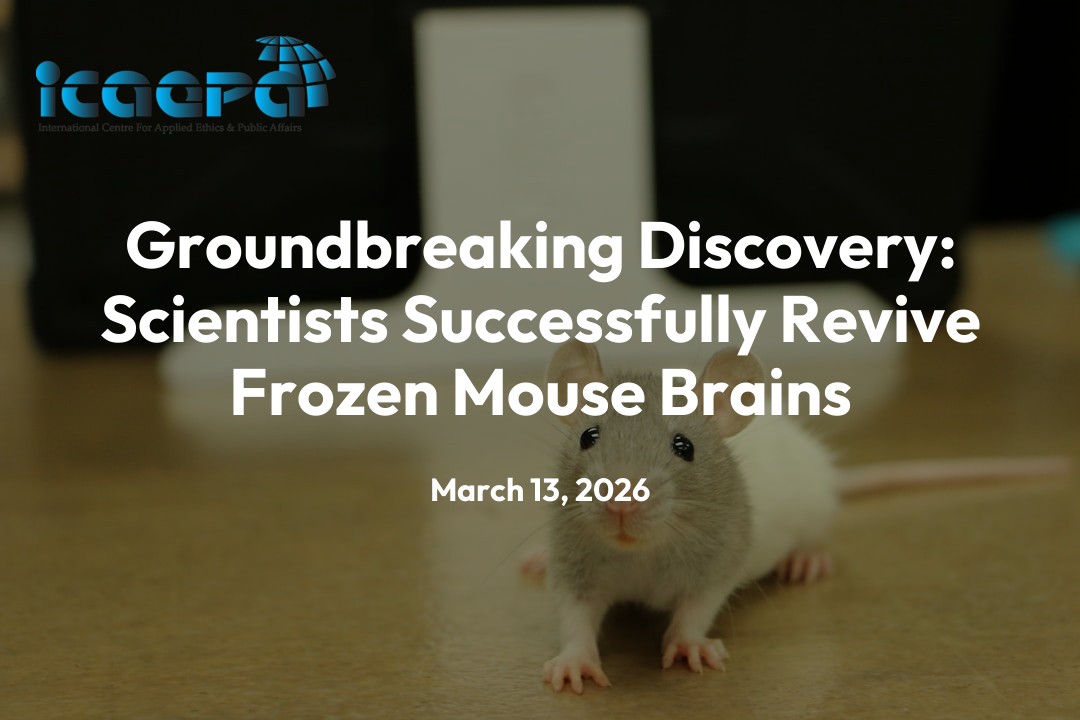
Groundbreaking Discovery: Scientists Successfully Revive Frozen Mouse Brains

a brown and white mouse

(Nature) – ‘Cryosleep’ remains the preserve of science fiction, but researchers are getting closer to restoring brain function after deep freezing.

Researchers attempting the cryogenic freezing and thawing of brain tissue from humans and other animals — mostly young vertebrates — have already shown that neuronal tissue can survive freezing on a cellular level and, after thawing, a functional one to some extent. But it has not been possible to fully restore the processes necessary for proper brain functioning — neuronal firing, cell metabolism and brain plasticity

A team in Germany has now demonstrated a method for cryopreserving and thawing mouse brains that leaves some of this functionality intact. (Read More)

Read Article
The Unspoken Truth: We’re All Burdens Eventually Bioethics Education
March 13, 2026

The Unspoken Truth: We’re All Burdens Eventually

Nurse helping an elderly female patient

(Plough) – As laws permitting medically assisted death advance, how will we learn to accept diminishment rather than kill ourselves?

I share this experience with Jens because I have been mulling over a parenting challenge, and I think the way I let Jens down that day points to a solution. As I have seen the slow advance of laws permitting medically assisted death, I have begun wondering how I can raise my children to grow into the sorts of people who would rather choose to endure the painful, humiliating loss of health and bodily function than to die by suicide. I believe that part of the answer to this parenting challenge is found by examining the problem of polite dishonesty when it comes to the ways we burden and are burdened by one another. These two experiences – being a burden and being burdened – are not the same, but for any who will resist the seduction of suicide as an escape from the reality that human life is burdensome, being a burden and bearing burdens must be taught and practiced. And I believe the first step is overcoming the polite dishonesty that denies people are burdens at all. (Read More)

Read Article